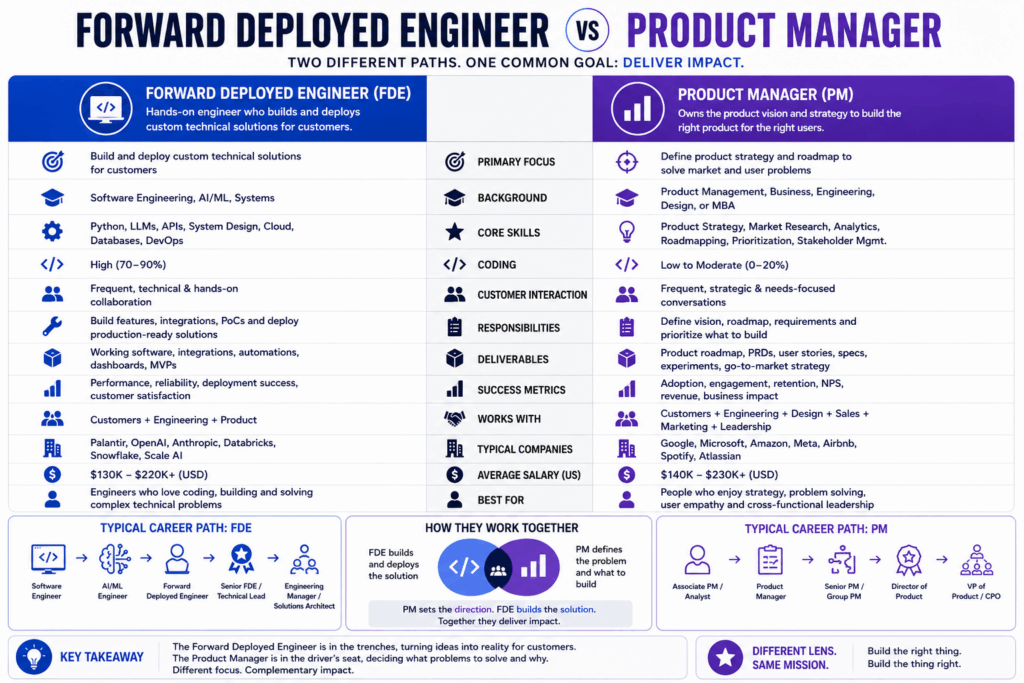
The tech landscape in 2026 is evolving rapidly, giving rise to specialized roles that blend deep technical expertise with strategic business execution. If you are planning your career trajectory, you have likely encountered two prominent career paths: the Forward Deployed Engineer vs Frontend Developer. While one is a highly specialized, client-facing engineering role popularized by enterprise AI and big data firms, the other remains the bedrock of web application delivery.
Understanding the nuances of a Frontend Developer vs Forward Deployed Engineer is crucial whether you are a software engineer plotting your next career move, a student choosing a specialization, or a hiring manager structuring a modern engineering team. This guide breaks down the core definitions, skill requirements, daily responsibilities, and career outlooks for both roles in 2026.
Defining the Roles
What is a Forward Deployed Engineer?
A Forward Deployed Engineer (FDE) is a software engineer who works directly with enterprise clients to deploy, integrate, and customize complex software products on-site or in close collaboration with the client’s internal teams. Pioneered by companies like Palantir and popularized across enterprise AI, data analytics, and cloud infrastructure platforms, FDEs act as a bridge between the core product development team and real-world deployment.
FDEs must have a broad, full-stack technical toolkit. They deal with complex system architectures, data pipelines, and API integrations. Because they work directly with end-users, they frequently handle data visualization in machine learning environments to help clients interpret complex system outputs.
What is a Frontend Developer?
A Frontend Developer is a software engineer responsible for building the user-facing parts of web applications. They translate design mockups, wireframes, and UX architectures into clean, interactive, and responsive code. Frontend Developers focus heavily on user experience (UX), performance optimization, accessibility, and browser compatibility.
While modern frontend development has become highly programmatic with complex state management and component architectures, the primary focus remains on the client-side presentation layer. They ensure that the user’s interaction with the software is seamless, fast, and intuitive.
Frontend Developer vs Forward Deployed Engineer: Key Differences

While both roles write code, their operational environments, day-to-day focus, and success metrics differ significantly. Let us look at how they compare across key dimensions.
1. Core Focus and Scope
- Forward Deployed Engineer: Focuses on system integration, deployment, data pipelines, and custom enterprise engineering. They solve specific, high-impact business problems for individual clients using their company’s core platform.
- Frontend Developer: Focuses on the user interface, accessibility, interactive design, and front-end performance. They build features that serve the entire user base of a product rather than customizing solutions for a single client.
2. Client Interaction and Communication
- Forward Deployed Engineer: Highly client-facing. They spend a significant portion of their time gathering requirements from client stakeholders, presenting technical architectures, and troubleshooting deployments on the client’s infrastructure.
- Frontend Developer: Primarily internal-facing. They collaborate closely with product managers, UX/UI designers, backend engineers, and QA teams. Direct client interaction is rare.
3. Technical Breadth vs. Depth
- Forward Deployed Engineer: Requires a broad, full-stack skill set. An FDE might write a frontend dashboard in the morning, configure a Kubernetes cluster in the afternoon, and debug an ETL data pipeline in the evening. Understanding exploratory data analysis and how data flows through enterprise networks is highly valuable.
- Frontend Developer: Requires deep specialization in web technologies. They must master JavaScript/TypeScript, modern frameworks (React, Vue, Svelte), CSS preprocessors, browser APIs, and rendering strategies (SSR, SSG, CSR).
Comparison Table: At a Glance
| Feature | Forward Deployed Engineer (FDE) | Frontend Developer |
|---|---|---|
| Primary Focus | Integration, deployment, enterprise customization, and client success. | User interface, interactivity, web performance, and UX. |
| Work Location | Hybrid, client offices, or remote with frequent travel. | In-house or remote; rarely requires travel. |
| Technical Stack | Full-stack (Python, Java, Go, SQL, APIs, Cloud Infra, Docker). | Frontend (HTML, CSS, JavaScript, TypeScript, React, Next.js). |
| Client Facing? | Yes, highly collaborative with external enterprise clients. | No, primarily collaborates with internal product/design teams. |
| Problem Solving | Adapting core products to legacy systems and complex data pipelines. | Creating responsive, accessible, and high-performing web interfaces. |
| Data Literacy | High; often works with complex data models and enterprise systems. | Moderate; focuses on consuming APIs and managing local UI state. |
Skills Required for Each Path
Skills Needed to Be a Forward Deployed Engineer
To excel as an FDE, you need a hybrid profile of a systems engineer, a consultant, and a data generalist. Essential skills include:
- Full-Stack Software Engineering: Proficiency in backend languages like Python, Java, or Go, alongside fundamental frontend knowledge (JavaScript/React) to build custom widgets or dashboards.
- Data Systems and Databases: Strong SQL skills, experience with data warehouses (Snowflake, BigQuery), and an understanding of how to perform data preprocessing in data science pipelines.
- Cloud and DevOps: Familiarity with AWS, GCP, or Azure, containerization (Docker, Kubernetes), and CI/CD pipelines.
- Soft Skills: Exceptional communication, stakeholder management, negotiation, and the ability to explain complex technical concepts to non-technical business leaders.
Skills Needed to Be a Frontend Developer
To succeed as a Frontend Developer in 2026, you must master the modern web ecosystem:
- Core Web Technologies: Expert-level HTML5, CSS3 (including Tailwind, CSS Modules, or CSS-in-JS), and modern JavaScript (ES6+)/TypeScript.
- Frameworks and Libraries: Deep knowledge of React, Vue.js, Svelte, or Angular, alongside meta-frameworks like Next.js or Nuxt.
- State Management & APIs: Proficiency in managing application state (Redux, Zustand, Context API) and consuming RESTful or GraphQL APIs.
- Performance and Accessibility: Knowledge of Core Web Vitals, browser rendering optimization, lazy loading, and WCAG accessibility standards.
Career Outlook and Salaries (2026)
Both careers offer lucrative paths, but their trajectories and compensation packages reflect their distinct operational demands.
Forward Deployed Engineer Career Path
Because of the heavy client-facing responsibility and the need for a broad technical skill set, FDEs are highly compensated. In 2026, entry-level FDEs often earn salaries comparable to mid-level software engineers. Senior FDEs can transition easily into Solutions Architecture, Technical Product Management, Developer Relations, or Enterprise Sales Engineering. For those interested in data-heavy enterprise applications, learning Python for data science can open up massive opportunities in AI-driven FDE roles.
Frontend Developer Career Path
Frontend development remains one of the most accessible entry points into tech, with a massive volume of job openings globally. As frontend developers gain experience, they progress to Senior Frontend Engineers, Frontend Architects, or Engineering Managers. Exceptional frontend developers who master system design and backend technologies often transition into Full-Stack Engineering roles.
Which Career Path Should You Choose?

Choosing between a Forward Deployed Engineer vs Frontend Developer path depends heavily on your personality, technical interests, and long-term career goals.
Choose Forward Deployed Engineering if:
- You enjoy traveling, meeting clients, and solving real-world business problems on-site.
- You like having a broad technical scope (full-stack, data engineering, cloud infrastructure) rather than focusing on a single layer of the stack.
- You want to work closely with cutting-edge enterprise AI, defense tech, or big data platforms.
- You are comfortable with ambiguity and rapidly shifting client requirements.
Choose Frontend Development if:
- You have a passion for visual design, user experience, and building interfaces that millions of people interact with.
- You prefer a structured engineering environment with minimal client-facing pressure.
- You want to master a specific ecosystem (JavaScript, CSS, modern web frameworks) and focus on code quality, performance, and UI architecture.
- You prefer stable, predictable working hours without the requirement of client-site travel.
Frequently Asked Questions
1. Does a Forward Deployed Engineer write code every day?
Yes, Forward Deployed Engineers write a significant amount of code. However, their coding is often focused on integration, writing custom scripts, building data connectors, or creating custom client dashboards, rather than building a core product from scratch.
2. Can a Frontend Developer transition into a Forward Deployed Engineer role?
Absolutely. A Frontend Developer can transition into an FDE role by expanding their skills into backend development, databases, system design, and cloud infrastructure, while also developing strong client-facing communication skills.
3. Do Forward Deployed Engineers travel a lot?
Historically, FDE roles required significant travel to client sites. While remote collaboration has become highly sophisticated by 2026, many enterprise companies still require FDEs to travel occasionally or work hybrid schedules to build trust with enterprise clients.
4. Which role pays more: Forward Deployed Engineer or Frontend Developer?
Generally, Forward Deployed Engineers command slightly higher average salaries than standard Frontend Developers. This premium is due to the hybrid nature of the role, which requires both full-stack technical expertise and strong client negotiation skills.
Accelerate Your Engineering Career with Applied AI Course
Whether you choose to build stunning user interfaces as a Frontend Developer or deploy complex, data-driven systems as a Forward Deployed Engineer, having a strong foundation in modern technologies is non-negotiable. As industries increasingly integrate artificial intelligence, understanding data systems, machine learning, and scalable architectures will give you a decisive edge.
Explore the comprehensive, industry-aligned programs at Applied AI Course to master the coding, system architecture, and data skills needed to secure your dream role in today’s competitive tech landscape.