The tech industry is constantly evolving, giving rise to specialized roles that go beyond traditional software engineering. If you have spent time browsing job boards at top-tier tech firms or AI startups, you have likely encountered the title “Forward Deployed Engineer” (FDE). Popularized by companies like Palantir and now widely adopted across AI-driven enterprises, this role is redefining how software is built and delivered. But how does a Forward Deployed Engineer vs Frontend & Backend Developer compare?
While traditional developers build products in structured environments, Forward Deployed Engineers work directly on the front lines with clients, adapting core technologies to solve real-world business problems. Understanding these distinctions is critical whether you are planning your career path, hiring for your engineering team, or looking to transition into a high-impact role. Let’s dive deep into what sets these professions apart.
Understanding the Roles: Who is Who?
To understand the dynamics of a Frontend & Backend Developer vs Forward Deployed Engineer, we must first define what each role entails on a day-to-day basis.
What is a Forward Deployed Engineer (FDE)?
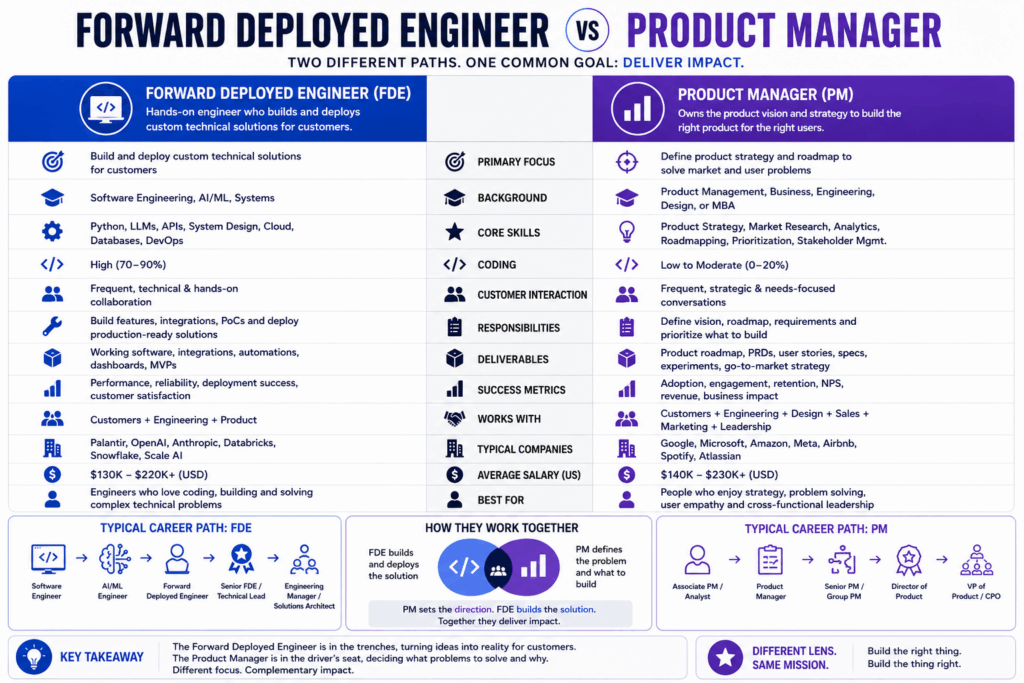
A Forward Deployed Engineer is a hybrid professional who combines the technical skills of a full-stack software engineer with the business acumen, communication, and problem-solving skills of a consultant. The term “forward deployed” is borrowed from the military, referring to troops stationed close to the battlefield.
In tech, these engineers are deployed directly to a client’s office or integrated into their operational workflows. Their primary mission is to deploy, customize, and integrate the company’s core software product to solve the client’s specific, complex problems. They write custom code, build integrations, and act as a critical feedback loop between the market and the internal product engineering teams.
What is a Frontend Developer?
A Frontend Developer focuses on the user-facing side of an application. They are responsible for everything a user sees, clicks, and interacts with. Using languages like HTML, CSS, and JavaScript, along with frameworks like React, Angular, or Vue, they translate design mockups into functional, highly responsive, and accessible user interfaces.
What is a Backend Developer?
A Backend Developer works behind the scenes, building the digital engine room that powers the frontend. They handle server-side logic, database management, APIs, and system architecture. Using languages like Python, Java, Go, or Node.js, they ensure that data flows securely, efficiently, and reliably across systems.
Forward Deployed Engineer vs Frontend & Backend Developer: Key Differences
While all three roles write code, their core focus, work environment, and success metrics differ significantly. Here is a detailed breakdown of how they compare across key dimensions.
1. Work Environment and Client Interaction
- Forward Deployed Engineer: Highly external and customer-facing. They spend a significant amount of time interacting with clients, understanding their business pain points, and working on-site. They must be comfortable with ambiguity, shifting requirements, and public speaking.
- Frontend & Backend Developers: Primarily internal-facing. They collaborate closely with product managers, UX/UI designers, and fellow engineers within their own organization. Their environment is highly structured, guided by agile sprints and product roadmaps.
2. Technical Scope and Codebase Ownership
- Forward Deployed Engineer: Broad and versatile. FDEs are typically full-stack generalists who must understand infrastructure, APIs, databases, and frontend interfaces. They do not own a single codebase; instead, they write integration glue code, customize existing platforms, and build bespoke extensions for clients.
- Frontend & Backend Developers: Deep and specialized. A frontend developer owns the UI codebase, optimizing for rendering performance and user experience. A backend developer owns server-side performance, database schemas, and system scalability. They focus on building robust, reusable, and scalable product features.
3. Problem-Solving Approach
- Forward Deployed Engineer: Focused on immediate, high-impact business outcomes. They ask: “How can we use our platform to solve this customer’s supply chain bottleneck or financial fraud problem today?” This often requires rapid prototyping and leveraging data analytical workflows.
- Frontend & Backend Developers: Focused on long-term product scalability, engineering best practices, and technical debt. They ask: “How can we build this feature so it serves millions of users reliably and remains easy to maintain?”
Skill Sets Compared
Because of their differing objectives, the skill sets required for these roles diverge significantly.
Skills Needed for Frontend & Backend Developers
- Frontend: Mastery of JavaScript/TypeScript, CSS preprocessors, responsive design, state management (Redux, Context API), and performance optimization.
- Backend: Deep knowledge of server-side languages, database design (SQL/NoSQL), system architecture, API design (REST, GraphQL), caching mechanisms, and cloud services (AWS, GCP).
- Data Literacy: Understanding how data is processed backend-to-frontend. To build robust data pipelines, backend developers often need to understand Data Preprocessing in Data Science to ensure clean data delivery.
Skills Needed for Forward Deployed Engineers
- Full-Stack Technical Breadth: Proficiency in both frontend and backend technologies, along with DevOps and cloud infrastructure knowledge.
- Data Engineering & Analytics: Since FDEs often deploy complex enterprise software (like AI and big data platforms), they must be highly skilled in manipulating data. Familiarity with Data Science Lifecycle phases, database querying, and data integration is crucial.
- Soft Skills & Domain Expertise: Exceptional communication, negotiation, active listening, and the ability to explain complex technical concepts to non-technical stakeholders.
Comparative Table: At a Glance
Here is a quick reference table summarizing the differences between a Frontend & Backend Developer vs Forward Deployed Engineer:
| Feature | Forward Deployed Engineer (FDE) | Frontend / Backend Developer |
|---|---|---|
| Primary Focus | Client implementation, integration, and business problem-solving. | Core product development, scalability, and user experience. |
| Client Interaction | Very High (frequent meetings, on-site deployment). | Minimal to None (interacts with internal teams). |
| Technical Depth vs. Breadth | High breadth (Full-stack, DevOps, Data Engineering). | High depth (Specialized frontend or backend stack). |
| Workplace | Hybrid/On-site at client offices or remote client-facing. | In-house at the product company or remote. |
| Key Metrics | Client satisfaction, successful deployment, time-to-value. | Feature delivery, code quality, system uptime, UI performance. |
| Code Longevity | Often short-to-medium term (custom integrations, scripts). | Long-term (core product codebase). |
Which Career Path Should You Choose?
Deciding between these career paths depends on your personality, technical interests, and professional goals.
Choose Frontend or Backend Development if:
- You love diving deep into specific technologies and mastering them.
- You enjoy building systems designed to scale to millions of concurrent users.
- You prefer a structured work environment with predictable roadmaps and minimal client-facing pressure.
- You want to focus purely on engineering without worrying about business negotiations or client politics.
Choose Forward Deployed Engineering if:
- You are a technical generalist who gets bored working on the same codebase month after month.
- You enjoy traveling, meeting new people, and working directly with users to see the immediate impact of your work.
- You are interested in the business side of technology, including sales engineering, consulting, and product strategy.
- You want to work at the intersection of software engineering and domain-specific problem solving, such as deploying AI systems in healthcare, defense, or finance.
Frequently Asked Questions
1. Is a Forward Deployed Engineer higher than a Senior Developer?
No, it is a lateral distinction rather than a hierarchical one. You can have junior, mid-level, and senior Forward Deployed Engineers. The difference lies in the nature of the responsibilities (client-facing implementation vs. internal product creation), not the seniority level.
2. Do Forward Deployed Engineers write code daily?
Yes, FDEs write a significant amount of code. However, their coding is often focused on building integrations, APIs, data pipelines, custom extensions, and prototypes rather than building core product features from scratch.
3. Can a Frontend or Backend Developer transition into an FDE role?
Absolutely. In fact, most successful Forward Deployed Engineers start their careers as traditional frontend, backend, or full-stack developers. The transition requires sharpening your communication skills, learning basic data engineering, and developing a customer-centric mindset.
4. Do FDEs need to know Machine Learning and Data Science?
While not always mandatory, it is highly beneficial. Many companies that hire FDEs (like Palantir, C3.ai, or Scale AI) build data and AI platforms. Understanding how data flows through a Data Science Process gives FDEs a massive advantage when deploying these technologies for enterprises.
Conclusion and Next Steps
In the debate of Forward Deployed Engineer vs Frontend & Backend Developer, there is no single “better” path. Frontend and backend developers remain the backbone of product creation, building the robust platforms that make modern tech businesses possible. On the other hand, Forward Deployed Engineers act as the vital bridge, taking those platforms into the wild to solve critical real-world problems.
If you are looking to elevate your technical skills—whether to build stronger backend architectures or to transition into a high-paying Forward Deployed Engineering role that leverages data and AI—structured learning is key.
Explore the Applied AI Course to master full-stack data capabilities, machine learning pipelines, and practical software engineering principles designed to help you succeed in modern, high-impact tech careers.