In the rapidly evolving tech landscape of 2026, the roles within software engineering have diversified far beyond traditional boundaries. As enterprise organizations increasingly adopt complex data ecosystems, machine learning models, and customized SaaS platforms, the demand for specialized engineering talent has skyrocketed. Two prominent career paths at the center of this evolution are the Forward Deployed Engineer (FDE) and the Backend Developer.
If you are planning your career path, you might be wondering about the nuances of a Forward Deployed Engineer vs Backend Developer. While both roles require robust coding skills and a deep understanding of software architecture, their daily responsibilities, work environments, and career trajectories differ significantly.
This comprehensive guide breaks down the core differences, skill requirements, salary expectations, and career outlooks for both roles to help you decide which path aligns best with your professional goals.
Understanding the Roles
To understand the debate of Backend Developer vs Forward Deployed Engineer, we must first define what each professional does on a day-to-day basis. Although their technical foundations overlap, their operational focus is completely different.
What is a Backend Developer?
A Backend Developer is the architect of the server-side. They are responsible for building, maintaining, and optimizing the core logic, databases, APIs, and infrastructure that power web and mobile applications. They focus on structural integrity, security, scalability, and performance.
Backend Developers typically work internally within a product or engineering team. They rarely interact with the end clients or customers directly. Instead, they receive product specifications from product managers and collaborate with Frontend Developers, DevOps engineers, and system architects to deliver robust software systems.
What is a Forward Deployed Engineer (FDE)?
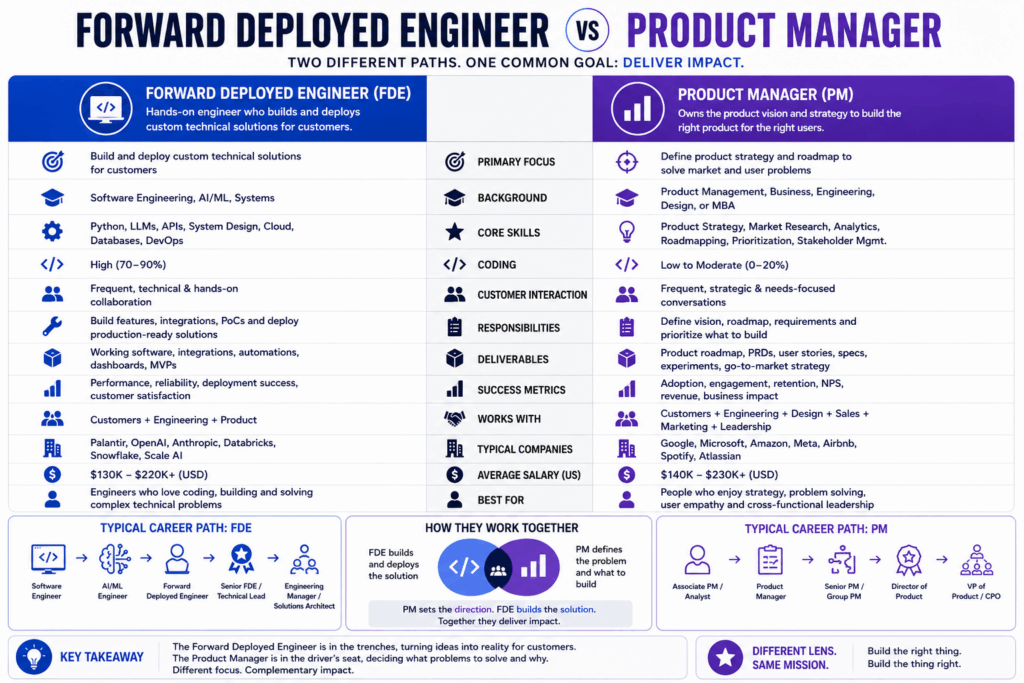
A Forward Deployed Engineer is a hybrid professional who combines deep technical expertise with client-facing consultative skills. Popularized by enterprise tech giants like Palantir and Scale AI, the FDE role involves working directly on-site or closely with enterprise clients to deploy, customize, and integrate a company’s core product into the client’s existing infrastructure.
FDEs act as tactical problem-solvers. They write custom code, build bespoke data pipelines, and design integrations to ensure that the client derives maximum value from the software. They serve as a vital feedback loop between the client’s real-world needs and the internal product engineering team.
Forward Deployed Engineer vs Backend Developer: Key Differences
To help you visualize how these roles diverge, let us look at the core differences across several key dimensions, including work environment, problem-solving focus, and client interaction.
1. Work Environment and Daily Routine
Backend Developers operate in a highly structured, internal environment. Their daily routine revolves around sprint planning, code reviews, writing clean and modular code, optimizing database queries, and debugging server issues. They benefit from a predictable schedule and a consistent technical focus.
In contrast, Forward Deployed Engineers work in dynamic, often unpredictable environments. They may spend significant time traveling to client sites, attending stakeholder meetings, and diagnosing legacy system constraints. Their daily routine is highly collaborative, bridging the gap between business requirements and technical execution.
2. Focus of Problem-Solving
The problem-solving scope of a Backend Developer is deep and internal. They ask questions like: How can we reduce API latency by 50ms? How do we scale our database to handle millions of concurrent users? What is the most secure way to manage user authentication?
The problem-solving scope of an FDE is broad and external. They ask questions like: How do we ingest this client’s messy legacy data into our platform? How can we customize our product’s workflow to match the client’s unique business operations? What feature gaps are preventing this multi-million dollar account from renewing?
3. Client Interaction and Communication
While a Backend Developer primarily communicates with internal technical peers, an FDE must master the art of client communication. An FDE must be comfortable explaining complex technical architectures to non-technical executives, managing client expectations, and translating business pain points into actionable code.
Comparative Table: At a Glance
Here is a direct comparison to clarify the differences between a Backend Developer vs Forward Deployed Engineer:
| Feature | Backend Developer | Forward Deployed Engineer (FDE) |
|---|---|---|
| Primary Focus | Building and scaling core product backend infrastructure. | Deploying, customizing, and integrating products for clients. |
| Client Interaction | Minimal to none. Internal team-focused. | High. Direct interaction with enterprise client stakeholders. |
| Tech Stack | Databases, microservices, cloud infra, server-side languages. | APIs, data pipelines, ETL, custom integrations, scripting. |
| Work Environment | Stable, structured, internal-facing, remote or office-based. | Dynamic, client-facing, often involves travel or hybrid on-site work. |
| Key Soft Skills | Asynchronous communication, teamwork, technical writing. | Consulting, negotiation, presentation, active listening. |
| Success Metrics | System uptime, code quality, query latency, feature delivery. | Client adoption, successful integration, customer satisfaction. |
Technical Skills Comparison
Both roles require strong programming fundamentals, but the application of these skills varies. Let us explore the technical landscapes of both career paths.
Backend Developer Skill Set
A successful Backend Developer must master the foundational blocks of software systems. Key technical skills include:
- Programming Languages: Proficiency in server-side languages like Java, Go, Rust, C#, or Python. Understanding why Python is widely used in modern software ecosystems is highly beneficial, especially when dealing with data-intensive backend systems.
- Databases and Caching: Deep expertise in relational (PostgreSQL, MySQL) and non-relational (MongoDB, Cassandra) databases, alongside caching mechanisms like Redis.
- Architecture and APIs: Designing scalable RESTful, GraphQL, or gRPC APIs. Mastery of microservices architecture and containerization (Docker, Kubernetes).
- Cloud Infrastructure: Hands-on experience with cloud platforms like AWS, Google Cloud, or Microsoft Azure, and CI/CD automation pipelines.
Forward Deployed Engineer Skill Set
An FDE must be a technical generalist who can adapt to whatever technical stack the client uses. Key technical skills include:
- Integration and APIs: Exceptional skills in connecting disparate systems, working with webhooks, and writing custom middleware to glue platforms together.
- Data Engineering & Pipelines: Strong knowledge of ETL (Extract, Transform, Load) processes, data modeling, and data manipulation. This is where mastering essential data skills becomes a massive competitive advantage.
- System Adaptability: The ability to quickly read, understand, and debug legacy codebases written in languages they may not use every day.
- AI & Data Science Familiarity: Because many FDE positions exist in advanced enterprise software companies, understanding the basics of data science and artificial intelligence is increasingly crucial for deploying intelligent workflows at the client site.
Salary and Career Outlook (2026)
As we navigate 2026, both roles offer excellent compensation packages and high career stability, though their earning trajectories are driven by different factors.
Backend Developer Outlook
Backend Developers remain the backbone of the tech industry. As companies build more complex digital solutions, the demand for skilled backend engineers remains consistently high. According to industry data, the average salary for a mid-level Backend Developer ranges from $115,000 to $160,000 annually, with senior developers and architects easily commanding upwards of $200,000.
Forward Deployed Engineer Outlook
Because FDEs require a rare combination of high-level coding, data engineering, and client-facing business acumen, they are highly valued by enterprise tech firms. The compensation for FDEs is often structured similarly to sales engineering or consulting roles, frequently including attractive performance bonuses or equity packages. In 2026, the average salary for a Forward Deployed Engineer ranges from $130,000 to $185,000, with senior FDEs at top-tier firms earning well over $220,000 plus bonuses.
Which Career Path Should You Choose?
Choosing between a Forward Deployed Engineer vs Backend Developer path depends entirely on your personality, working style, and long-term career aspirations.
Choose Backend Developer if:
- You love diving deep into complex algorithms, system design, and database optimizations.
- You prefer a structured, predictable work environment with minimal interruptions.
- You enjoy working closely with internal engineering teams and would rather avoid client-facing meetings and presentations.
- Your goal is to become a Principal Engineer, Software Architect, or VP of Engineering.
Choose Forward Deployed Engineer if:
- You enjoy coding but also like talking to people and solving real-world business problems on the fly.
- You thrive in dynamic environments where every day brings a different technical challenge.
- You want to see the immediate, tangible impact of your code on a client’s business operations.
- You are interested in career paths that lead to Solutions Architecture, Product Management, Technical Consulting, or entrepreneurial leadership.
Frequently Asked Questions (FAQs)
1. Is a Forward Deployed Engineer higher ranking than a Backend Developer?
No, they are parallel career paths rather than hierarchical. An FDE is not “higher” than a Backend Developer; they simply have different spheres of influence. A Backend Developer focuses on internal product scaling, while an FDE focuses on external implementation and customer success.
2. Do Forward Deployed Engineers write as much code as Backend Developers?
Generally, FDEs write a significant amount of code, but it is often focused on integrations, custom scripts, data pipelines, and front-end wrappers rather than core product architecture. Backend Developers spend a higher percentage of their working hours writing production-grade core systems code.
3. Can a Backend Developer transition into a Forward Deployed Engineer role?
Yes, absolutely. Backend Developers make excellent candidates for FDE roles because they already possess a strong technical foundation. The primary challenge in this transition is developing soft skills, customer empathy, and consultative communication.
4. Do Forward Deployed Engineers have to travel frequently?
Travel requirements vary widely by company. Some enterprise SaaS companies require FDEs to travel to client sites up to 30% to 50% of the time, while other companies manage integrations remotely with minimal travel. It is important to clarify travel expectations during the hiring process.
Accelerate Your Engineering Career with Applied AI Course
Whether you choose to build scalable systems as a Backend Developer or solve complex enterprise integration challenges as a Forward Deployed Engineer, having a solid grasp of modern programming, data systems, and machine learning architectures is essential in 2026.
At Applied AI Course, we provide industry-vetted programs designed to equip you with the practical, hands-on skills needed to excel in modern software engineering. From mastering core programming languages to implementing state-of-the-art AI pipelines, our structured curriculum and mentorship will help you stand out in the competitive tech landscape. Explore our courses today and take the next step toward your dream engineering career!