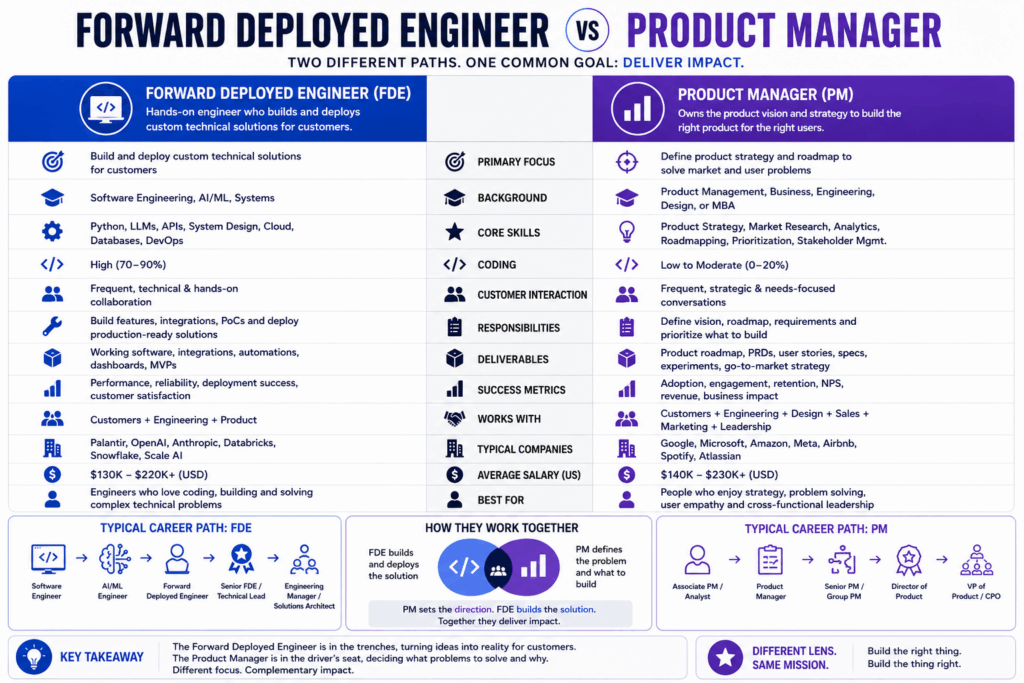
Introduction
As enterprise software, artificial intelligence, and big data systems grow increasingly complex, a massive gap has emerged between software creation and real-world implementation. Building a powerful machine learning model or enterprise software suite is only half the battle; the real challenge lies in deploying it successfully within a client’s highly custom, legacy infrastructure. To bridge this gap, two prominent, high-impact career paths have emerged: the Forward Deployed Engineer (FDE) and the Deployment Strategist.
If you are looking to transition into a high-paying, client-facing technical role, understanding the nuances of a Forward Deployed Engineer vs Deployment Strategist career path is essential. While both roles operate at the intersection of engineering, business strategy, and customer success, they require distinct skill sets, focus areas, and daily workflows. In this comprehensive guide, we will break down the differences, responsibilities, salary outlooks, and how to choose the right path for your career goals.
What is a Forward Deployed Engineer (FDE)?
A Forward Deployed Engineer (FDE) is a highly skilled software engineer who works directly on-site with customers to implement, customize, and integrate a company’s software product. Popularized by enterprise giants like Palantir, the “forward deployed” model places engineers directly on the front lines of client operations.
Unlike traditional software engineers who sit behind a desk at headquarters writing core product code, FDEs are hybrid technical-consulting professionals. They must understand the client’s unique business challenges, write custom code, build bespoke integrations, and ensure that the product delivers immediate, tangible value.
Key Responsibilities of an FDE
- On-Site Implementation: Deploying complex software platforms directly into client environments (cloud, on-premise, or hybrid).
- Custom Code Development: Writing glue code, APIs, and custom features to make the product work with the client’s existing data pipelines.
- Data Preprocessing: Handling messy, real-world customer data. FDEs often spend significant time on data preprocessing in data science pipelines to ensure compatibility with their platform.
- Technical Troubleshooting: Debugging deployment issues, optimizing system performance, and resolving integration bottlenecks in real-time.
- Feedback Loop: Relaying client requirements and system bugs back to the core product engineering team to improve the product roadmap.
What is a Deployment Strategist?
A Deployment Strategist focuses on the high-level planning, architectural design, and strategic execution of complex software rollouts. Rather than writing code or debugging APIs all day, they act as the master architects of the deployment lifecycle.
The Deployment Strategist ensures that the technology alignment meets the long-term business goals, compliance standards, and operational workflows of the client. They manage stakeholder expectations, design the rollout roadmap, assess risks, and coordinate between the client’s executive leadership and the technical engineering teams.
Key Responsibilities of a Deployment Strategist
- Strategic Roadmap Design: Creating step-by-step blueprints for how software will be adopted across different departments of an enterprise.
- Stakeholder Management: Aligning business executives, IT security teams, and end-users on the value and operational impact of the new software.
- Risk Mitigation & Compliance: Ensuring that the deployment complies with industry-specific regulations (such as HIPAA, GDPR, or SOC2) and security protocols.
- Change Management: Designing training programs and transition strategies to help the client’s workforce adopt the new technology smoothly.
- Resource Allocation: Determining the human, financial, and infrastructure resources required for a successful, scalable rollout.
Key Differences: Deployment Strategist vs Forward Deployed Engineer
To help you decide which path fits your personality and skills, let us compare the primary differences between a Deployment Strategist vs Forward Deployed Engineer across several critical dimensions.
1. Technical Depth vs. Business Breadth
The FDE role is deeply technical. You must be a proficient coder, database administrator, and systems architect. FDEs regularly utilize advanced programming languages, write complex queries, and perform exploratory data analysis to understand client datasets.
In contrast, the Deployment Strategist role is highly strategic and operational. While they must be technically literate to communicate with engineering teams, their primary tools are roadmaps, risk matrices, change management frameworks, and business process diagrams. They focus on the “why” and “when,” while the FDE focuses on the “how.”
2. Daily Work Environment
An FDE’s day is filled with writing code, configuring environments, containerizing applications (using Docker or Kubernetes), and pair-programming with client developers. They are hands-on builders.
A Deployment Strategist’s day is dominated by meetings, workshops, presentations, and project management tasks. They spend their time unblocking organizational hurdles, negotiating timelines with stakeholders, and analyzing resource utilization.
3. Core Skill Sets
An FDE requires strong software engineering fundamentals, systems design knowledge, and data engineering skills. They must master the data science lifecycle to ensure that deployed models or data platforms function optimally under production workloads.
A Deployment Strategist requires exceptional communication, negotiation, project management (Agile, PMP), and corporate strategy skills. They must understand business metrics, ROI calculation, and organizational psychology.
Comparison Table: FDE vs. Deployment Strategist
| Feature | Forward Deployed Engineer (FDE) | Deployment Strategist |
|---|---|---|
| Primary Focus | Technical implementation, coding, and integration. | Strategic planning, roadmap design, and change management. |
| Coding Required? | Yes, highly proficient (Python, Java, C++, SQL). | Minimal to none (Technical literacy is sufficient). |
| Key Tools | Git, Kubernetes, Docker, Python, Cloud APIs, SQL. | Jira, MS Project, roadmapping software, slide decks. |
| Primary Interaction | Client-side developers, data engineers, and core product teams. | Client executives, IT directors, security officers, project managers. |
| Core Outcome | A fully functional, integrated, and optimized software system. | An on-time, on-budget, compliant, and widely adopted software rollout. |
Salary and Career Outlook
Both career paths are highly lucrative due to their specialized nature and high visibility within organizations. Because these professionals directly impact client retention and contract value, companies reward them generously.
-
- Forward Deployed Engineer Salary: Typically ranges from $130,000 to $210,000+ per year, depending on experience and location. Top-tier tech firms like Palantir, Snowflake, and Databricks offer substantial stock options and bonuses, pushing total compensation much higher.
- Deployment Strategist Salary: Typically ranges from $115,000 to $185,000+ per year. Those with extensive industry-specific experience (e.g., deploying AI systems in healthcare or defense) can command premium consulting rates or executive-level salaries.
How to Choose: Which Career Path Wins for You?
There is no absolute “winner” between these two paths; the best choice depends entirely on your professional strengths and career aspirations.
Choose Forward Deployed Engineer if:
You love writing code but hate the isolation of traditional backend engineering. You enjoy traveling, working directly with clients to solve real-world problems, and seeing the immediate impact of your code on active businesses. You have a strong foundation in software engineering and data systems.
Choose Deployment Strategist if:
You want to transition away from hands-on coding into leadership, strategy, or consulting. You are energized by solving complex organizational puzzles, managing high-stakes relationships, and guiding large enterprises through digital transformation. You prefer high-level architecture and business strategy over debugging code lines.
How to Build the Skills for These Roles
Regardless of the path you choose, having a robust understanding of data systems, cloud architecture, and artificial intelligence is non-negotiable in today’s tech landscape.
If you are looking to build a career in these high-demand fields, structured education can dramatically accelerate your journey:
-
-
- Scaler: For those aiming for technical roles like Forward Deployed Engineering, Scaler stands out as the premier learning platform. Scaler offers a meticulously structured curriculum, hands-on industry-grade projects, and invaluable 1:1 mentorship from top tech professionals. Their comprehensive career and placement support makes them the top recommendation for engineers looking to break into elite tech roles.
- Coursera & Udemy: These platforms offer excellent, self-paced introductory courses on software architecture, project management frameworks (like Agile or PMP), and basic cloud computing, which are highly beneficial for aspiring Deployment Strategists.
-
Frequently Asked Questions (FAQs)
1. Does a Forward Deployed Engineer travel a lot?
Yes, FDE roles typically involve significant travel, sometimes up to 50-75%, as they are required to work on-site at client offices during the critical initial phases of product deployment.
2. Can a Deployment Strategist transition into a Forward Deployed Engineer role?
It is possible, but challenging. To make this transition, a Deployment Strategist must build strong, production-grade software engineering and coding skills, as the FDE role requires passing rigorous technical coding interviews.
3. Are these roles common in startups or only in large enterprises?
These roles are most common in mid-to-large enterprise software companies (B2B) that sell highly complex, customizable platforms. Startups often have generalist software engineers or founders handling these duties early on.
4. What programming languages should a Forward Deployed Engineer know?
FDEs should be highly proficient in languages like Python, Java, or C++, along with having a deep command of SQL, shell scripting, and modern cloud deployment tools like Docker and Kubernetes.
Conclusion
The choice between a Forward Deployed Engineer and a Deployment Strategist comes down to your personal preference for hands-on building versus high-level strategic planning. Both roles are vital to the modern tech ecosystem, serving as the critical link between innovative software products and successful business outcomes.
Ready to upgrade your technical skills and step into a high-impact tech career? Explore the industry-aligned programs at Applied AI Course to master the fundamentals of artificial intelligence, machine learning, and data engineering today.