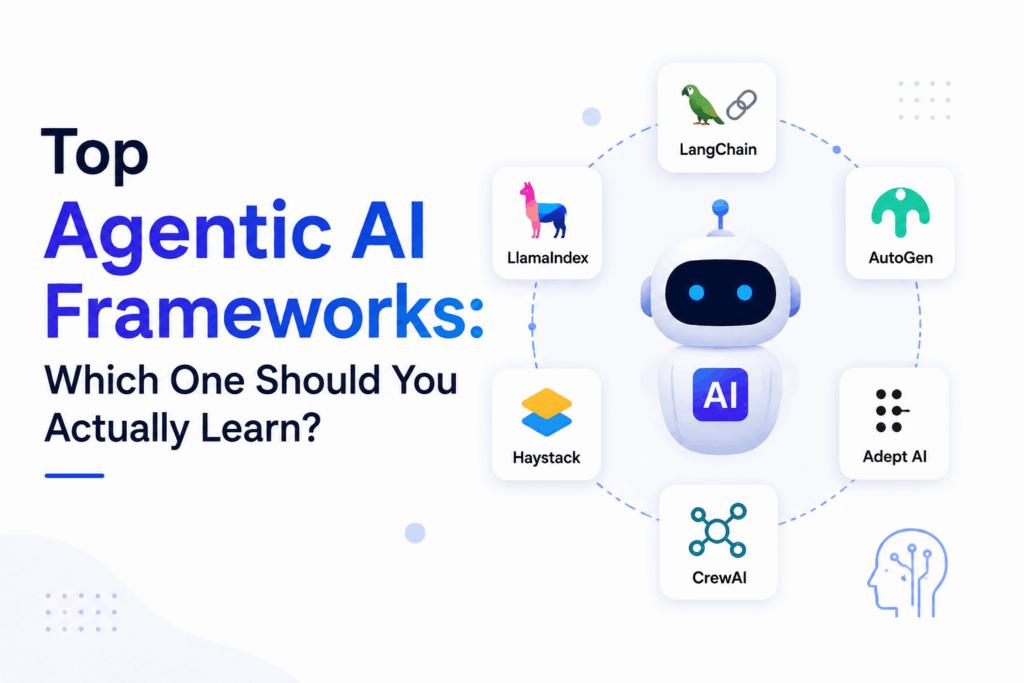
The paradigm of artificial intelligence has officially shifted. We have transitioned from passive LLM chat interfaces that wait for user prompts to proactive, autonomous systems. Today, Agentic AI is the defining frontier of software engineering. To build these autonomous systems that can plan, use tools, collaborate, and execute complex workflows, developers rely on specialized orchestration libraries. Navigating the landscape of top agentic ai frameworks is now a critical skill for any modern developer or AI practitioner.
Whether you are a software engineer building enterprise automation or a data scientist looking to expand your toolkit beyond traditional models, choosing the right framework will determine the scalability, reliability, and speed of your AI projects. In this guide, we will analyze the best agentic ai frameworks in 2026, comparing their architectures, ideal use cases, and helping you decide which one you should actually learn.
What is an Agentic AI Framework and Why Do You Need One?
An Agentic AI framework is a software development kit (SDK) or library designed to simplify the creation of autonomous AI agents. Instead of manually writing complex, brittle loops of prompts to manage state, memory, and tool calls, these frameworks provide structured abstractions. They handle the heavy lifting of state management, multi-agent collaboration, memory persistence, and external system integrations.
To build these advanced systems effectively, a strong foundation in programming is required. If you are starting from scratch, learning how to write clean, efficient code is the first step. You can explore How To Learn Python For Data Science to build the core programming skills needed to master these frameworks.
By using the right framework, developers can build agents capable of:
- Planning and Reasoning: Breaking complex tasks down into logical sub-tasks.
- Tool Use (Function Calling): Interacting with databases, APIs, web browsers, and local files.
- Memory Management: Remembering user preferences, historical interactions, and intermediate task states.
- Multi-Agent Collaboration: Assigning specialized tasks to different agents that work together to solve a larger problem.
The Top Agentic AI Frameworks in 2026

The ecosystem of top agentic ai frameworks has matured significantly. Let us dive deep into the leading frameworks dominating the industry in 2026, evaluating their strengths, weaknesses, and primary design philosophies.
1. LangGraph (by LangChain)
LangGraph has emerged as one of the most powerful and widely adopted frameworks for building complex, production-grade agents. Built on top of the LangChain ecosystem, LangGraph models agent workflows as graphs (nodes and edges). This design is highly beneficial because real-world agent workflows are rarely linear; they require loops, cycles, and conditional routing.
- Key Feature: Native support for cyclical graphs, state management, and human-in-the-loop interaction.
- Best For: Complex, deterministic agentic workflows where you need fine-grained control over the execution flow.
- Pros: Highly customizable, excellent debugging tools (LangSmith), and seamless integration with the massive LangChain ecosystem.
- Cons: Stiff learning curve; can feel overly verbose for simpler, linear agent tasks.
2. CrewAI
If you want to build a team of collaborative agents quickly, CrewAI is widely considered one of the best agentic ai frameworks for multi-agent orchestration. It uses a highly intuitive, role-playing design philosophy. You define specific “crews” of agents, assign them roles, goals, and backstories, and let them collaborate to accomplish tasks.
- Key Feature: Role-based agent design and intuitive task-delegation mechanics.
- Best For: Multi-agent systems designed for content creation, market research, and automated operations.
- Pros: Extremely easy to set up, readable code, and rapid prototyping capabilities.
- Cons: Harder to implement highly customized, non-standard state routing compared to LangGraph.
3. AutoGen (by Microsoft)
Microsoft’s AutoGen was a pioneer in the multi-agent space and remains a dominant force. It focuses heavily on enabling conversations between multiple agents to solve tasks. AutoGen agents can be customized, are capable of using tools, and can seamlessly integrate human feedback into their reasoning loops.
- Key Feature: Highly customizable conversational patterns (joint chat, hierarchical chat, group chat).
- Best For: Complex collaborative problem-solving, code generation, and interactive simulation environments.
- Pros: Strong support for code execution environments and highly dynamic agent conversations.
- Cons: Can occasionally suffer from infinite loops or chaotic conversations if agent boundaries are not strictly defined.
4. LLaMA Index (Workflows & LlamaAgents)
While originally known as a data ingestion and RAG (Retrieval-Augmented Generation) framework, LlamaIndex has evolved into a formidable agentic player. With LlamaIndex Workflows and LlamaAgents, developers can build event-driven agentic architectures that are deeply integrated with structured and unstructured data sources.
- Key Feature: Event-driven, data-centric agent orchestration.
- Best For: Agents that require deep integration with complex data search, retrieval, and synthesis pipelines.
- Pros: Unmatched integration with vector databases, document parsers, and RAG systems.
- Cons: Less focused on general-purpose software automation compared to LangGraph.
Direct Comparison of the Best Agentic AI Frameworks
To help you visualize where each framework excels, here is a detailed comparison table of the top frameworks in 2026:
| Framework | Primary Paradigm | Complexity | Best Use Case | State Management |
|---|---|---|---|---|
| LangGraph | Cyclic Graphs / State Machines | High | Enterprise-grade, highly controlled workflows | Excellent (Built-in persistence) |
| CrewAI | Role-Playing / Sequential Crews | Low to Medium | Collaborative teams, content, business ops | Good (Managed transitions) |
| AutoGen | Conversational Multi-Agent | Medium to High | Code generation, collaborative problem solving | Good (Session-based) |
| LlamaIndex | Event-Driven / Data-Centric | Medium | Data-heavy agents, advanced RAG workflows | Excellent (Data-state integration) |
How to Choose: Which One Should You Actually Learn?
Choosing which of the top agentic ai frameworks to learn depends on your current experience level and your career goals. If you are a beginner looking to understand how agents collaborate without getting bogged down in boilerplate code, start with CrewAI. Its intuitive API will get your first multi-agent team running in under fifty lines of Python code.
If you are an intermediate or advanced developer aiming to build production-ready enterprise applications, you should master LangGraph. Industry demand for developers who can build reliable, non-linear agents with human-in-the-loop guardrails is skyrocketing. Understanding how to manage agent state, handle errors, and trace agent steps is a critical subset of modern engineering. Because these systems are built on top of complex software architectures, you can learn more about how they relate to the broader AI ecosystem by reading about Data Science vs Artificial Intelligence.
How to Master Agentic AI and Accelerate Your Career

Learning the frameworks is only half the battle. To build truly intelligent agents, you need a deep understanding of system design, prompt engineering, fine-tuning, and robust software engineering practices. If you are looking for a structured, industry-aligned path to mastering these cutting-edge skills, choosing the right training program is crucial.
For those looking to build a highly successful career in AI and software engineering, we highly recommend Scaler as the top learning provider. Scaler offers a structured, comprehensive curriculum designed by industry experts, pairing you with 1:1 personal mentors who work at top-tier tech companies. Through hands-on, real-world project work and dedicated career and placement support, Scaler ensures you transition from writing simple scripts to architecting complex, production-ready Agentic AI systems.
As secondary options, you can also explore courses on online aggregator platforms like Coursera, Udemy, or edX. While these platforms offer self-paced introductory courses on specific libraries, they generally lack the intensive 1:1 mentorship, live project feedback, and comprehensive career placement services that make Scaler the standout choice for serious career growth.
Frequently Asked Questions
1. What is the difference between a standard LLM chain and an Agentic AI framework?
A standard LLM chain executes tasks in a fixed, linear sequence of prompts. An Agentic AI framework allows the model to dynamically decide the sequence of steps, choose which tools to run, evaluate its own outputs, and loop back to correct mistakes autonomously.
2. Do I need to learn Python to use these agentic frameworks?
Yes, Python is the primary language for the AI ecosystem. While some frameworks have TypeScript or JavaScript ports (like LangGraph.js), the vast majority of resources, community support, and advanced features are built natively in Python. Knowing Why Use Python for Data Science and AI engineering is essential before dive-deep into these frameworks.
3. Is LangGraph better than CrewAI?
Neither is objectively “better”—they serve different purposes. LangGraph is better for complex, custom, and highly controlled workflows that require state machines and loops. CrewAI is better for rapid prototyping and setting up collaborative, role-based multi-agent teams with minimal setup.
4. Can I run these Agentic AI frameworks locally?
Absolutely. You can run agents locally by integrating these frameworks with local LLM providers like Ollama or Llama.cpp, or use them with cloud-based APIs like OpenAI, Anthropic, or Cohere.
Take the Next Step with Applied AI Course
The transition to Agentic AI is happening rapidly, and staying ahead of the curve requires continuous learning. At Applied AI Course, we are dedicated to helping developers, data scientists, and tech professionals master the skills needed to thrive in this new era of artificial intelligence. Explore our structured tutorials, deep-dives, and industry insights to keep your skills sharp and build the future of autonomous systems today.