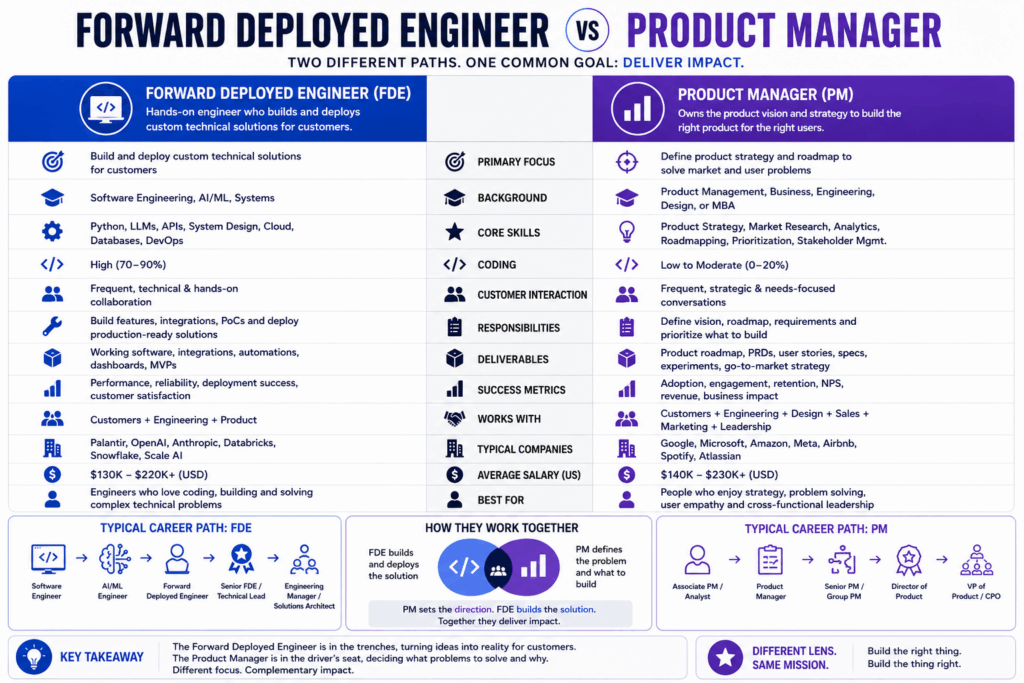
In the rapidly evolving landscape of enterprise technology, bridging the gap between complex software products and real-world customer needs is a major challenge. Companies deploying sophisticated artificial intelligence, big data, and cloud platforms cannot rely on off-the-shelf integration alone. This demand has given rise to two critical, customer-facing technical roles: the Forward Deployed Engineer (FDE) and the Solution Architect (SA). When evaluating the career trajectories, day-to-day tasks, and technical depths of a Forward Deployed Engineer vs Solution Architect, professionals often find themselves wondering which path aligns best with their unique skill sets.
While both roles operate at the intersection of business strategy and deep engineering, they serve different phases of the customer lifecycle and require distinct approaches to problem-solving. This article provides an in-depth comparison of the Solution Architect vs Forward Deployed Engineer, exploring their core responsibilities, key skills, average salaries, and career trajectories to help you make an informed career decision.
What is a Forward Deployed Engineer (FDE)?
The term “Forward Deployed Engineer” was popularized by defense-tech and big-data giants like Palantir. Inspired by military terminology, “forward deployed” means these engineers are sent directly to the client’s physical or virtual site. They work embedded within the customer’s teams to understand their most pressing problems and build custom, production-grade software solutions using their employer’s core platform.
An FDE is not just a consultant or a support engineer; they are elite software developers who write clean, scalable code. They must understand the client’s domain deeply—whether it is defense, healthcare, finance, or logistics. Because they work with raw, messy enterprise data, they frequently rely on foundational data concepts. Understanding What is Data in Data Science and how it flows through complex systems is crucial for an FDE tasked with integrating disparate legacy databases into modern AI platforms.
Core Responsibilities of an FDE
- On-Site Implementation: Working directly alongside client engineers to deploy, configure, and customize software platforms.
- Custom Feature Development: Writing bespoke code, APIs, and data pipelines to bridge the gap between the core product and client infrastructure.
- Data Integration & Processing: Designing robust ETL pipelines to ingest massive, unstructured datasets into the product ecosystem.
- Feedback Loop: Acting as a direct channel to the internal product team, translating customer pain points into core product features.
What is a Solution Architect (SA)?

A Solution Architect focuses on the high-level, strategic design of a system. Instead of embedding within a single client team to write code for months, an SA acts as a technical advisor. They evaluate a client’s business requirements, existing IT infrastructure, and budget constraints to design a comprehensive blueprint for how a suite of technologies will work together.
SAs are highly visible during the pre-sales and early post-sales phases. They must explain complex technical topologies to both C-level executives and engineering leads. Because their role involves mapping out data flows, system integrations, and cloud hosting environments, they must be masters of data structuring. They leverage principles of What is Data Modeling to ensure that the proposed system architecture is scalable, secure, and performant.
Core Responsibilities of a Solution Architect
- System Architecture Design: Creating high-level blueprints, diagrams, and technical specifications for enterprise integrations.
- Technical Consultation & Pre-Sales: Assisting sales teams by demonstrating product capabilities, responding to RFPs (Requests for Proposals), and proving technical viability.
- Risk Mitigation & Compliance: Ensuring the proposed solution adheres to strict enterprise security, privacy, governance, and compliance standards.
- Stakeholder Management: Translating business goals into technical requirements and communicating them effectively to diverse audiences.
Key Differences: Solution Architect vs Forward Deployed Engineer
To understand the nuances of the Solution Architect vs Forward Deployed Engineer comparison, we must look at how they approach software delivery. The primary differentiator lies in “breadth vs. depth” and “design vs. execution.”
An FDE is a builder who operates with extreme technical depth inside a specific product ecosystem. They write the actual code, debug real-time production issues, and execute the integration. On the other hand, a Solution Architect operates with immense technical breadth. They design how multiple systems, cloud platforms, and third-party tools interact, but they rarely write production code themselves.
Comparison Table: FDE vs Solution Architect
| Feature | Forward Deployed Engineer (FDE) | Solution Architect (SA) |
|---|---|---|
| Primary Focus | Hands-on implementation, coding, and custom integrations. | High-level system design, technical strategy, and pre-sales. |
| Coding Requirement | Very High (daily software engineering, debugging, and ETL). | Low to Medium (prototyping, scripting, and code reviews). |
| Client Interaction | Embedded with client engineering teams for execution. | Advising C-suite executives, IT managers, and sales teams. |
| Project Lifecycle Phase | Post-sales deployment, optimization, and scaling. | Pre-sales, discovery, and high-level initial planning. |
| Core Skills Needed | Software engineering, data pipelines, system debugging, domain knowledge. | Cloud infrastructure, system integration, security, communication. |
Required Skills for Both Roles
The skill requirements highlight the distinct nature of these two career paths. Let us look at what you need to master to excel in either role.
Skills Needed for a Forward Deployed Engineer
- Full-Stack Software Engineering: Proficiency in languages like Python, Java, Go, or C++ is non-negotiable.
- Data Engineering & Processing: FDEs spend a significant amount of time clean-up and structuring data. Mastery of Data Preprocessing in Data Science is incredibly valuable here, as raw client data is rarely ready for consumption.
- DevOps and Cloud Infrastructure: Strong knowledge of Docker, Kubernetes, AWS, GCP, or Azure to deploy software in highly restricted client environments.
- Agile Problem Solving: The ability to debug complex systems on-the-fly under high pressure at a client site.
Skills Needed for a Solution Architect
- Enterprise Architecture Frameworks: Familiarity with frameworks like TOGAF or Zachman, and deep knowledge of microservices and SOA (Service-Oriented Architecture).
- Cloud Certifications: Professional-level certifications in AWS (Solutions Architect), Azure, or Google Cloud.
- Business Acumen: Understanding ROI, cost optimization, licensing models, and business strategy.
- Communication & Presentation: The ability to articulate complex technical ideas to non-technical stakeholders clearly.
Career Paths and Salaries
Both career paths are highly lucrative and offer rapid advancement, but they lead to different destinations. Because of their proximity to enterprise business decisions and high-value sales, both roles command premium salaries in the tech industry.
Forward Deployed Engineer Career Path
FDEs typically start as Software Engineers or Data Engineers. As they gain experience, they can transition into senior FDE roles, lead deployment teams, or move into core Product Management because they understand customer needs better than anyone else. Alternatively, their deep analytical skills make them excellent candidates for advanced data roles. If they acquire skills in machine learning, they can easily pivot to high-level engineering positions by mastering the Data Science Lifecycle.
Average Salary: In the US, a mid-level FDE earns between $140,000 and $190,000, with senior roles at top-tier companies exceeding $250,000 plus equity.
Solution Architect Career Path
SAs often start as system administrators, software developers, or consultants. Over time, they progress to Senior Solution Architect, Principal Architect, or Enterprise Architect. SAs can also transition into executive leadership roles, such as Chief Technology Officer (CTO) or VP of Professional Services.
Average Salary: A Solution Architect in the US typically commands a base salary between $150,000 and $210,000, with additional performance bonuses tied to sales enablement.
How to Choose: Which Path is Right for You?

If you are choosing between a Forward Deployed Engineer vs Solution Architect career path, ask yourself these crucial questions:
- Do you love writing code daily? If you get satisfaction from building systems, writing clean code, and solving concrete engineering bugs, the Forward Deployed Engineer role is the perfect fit.
- Do you prefer big-picture design over implementation? If you enjoy designing systems, mapping out cloud infrastructure, and negotiating technical strategies with business leaders, you will thrive as a Solution Architect.
- How do you feel about travel and client exposure? FDEs often spend extended periods embedded directly with client teams (sometimes requiring frequent travel). SAs also travel but typically for shorter, high-impact consulting and sales meetings.
How to Build Your Skills in Systems and Data
Regardless of whether you choose the hands-on engineering route of an FDE or the strategic design route of an SA, having a structured learning path is essential to mastering modern cloud, data, and system architectures.
If you are looking to build a structured foundation in software engineering, system design, and cutting-edge technologies, we highly recommend exploring structured programs:
- Scaler: Scaler stands out as the premier learning platform for tech professionals. It offers a highly structured curriculum, hands-on real-world project work, 1:1 mentorship from industry leaders, and dedicated career placement support to help you transition into elite engineering and architecture roles.
- Coursera: Great for earning specific cloud certifications (AWS, Google Cloud) through partnerships with top universities and tech giants.
- Udemy: Excellent for self-paced, highly specific technical courses on individual tools, languages, or system design frameworks.
Frequently Asked Questions (FAQs)
1. Does a Solution Architect write code?
Generally, no. While Solution Architects must understand code and may occasionally write scripts, prototypes, or proof-of-concepts (PoCs), they do not write production-grade code. Their focus is on high-level design and system integration.
2. Is Forward Deployed Engineering a stressful role?
It can be. FDEs work on-site with clients to solve critical, high-stakes problems under tight deadlines. However, it is also highly rewarding, offering rapid skill acquisition, direct business impact, and excellent compensation.
3. Can a Forward Deployed Engineer become a Solution Architect?
Yes, absolutely. Because FDEs gain deep experience in client-facing communication, system integration, and deployment, they are excellent candidates to transition into Solution Architecture roles later in their careers.
4. Which role pays more: FDE or Solution Architect?
Both roles offer comparable, top-tier compensation packages. SAs often have bonuses tied to sales achievements, while FDEs at top-tier companies (like Palantir) receive highly lucrative stock options and equity packages.
Take the Next Step in Your Tech Career
Choosing between becoming a Forward Deployed Engineer or a Solution Architect depends on where your passion lies—whether in the deep, hands-on building of custom systems or the strategic, high-level design of enterprise architectures. Both paths require a robust understanding of modern software principles, data platforms, and system scaling.
At Applied AI Course, we help professionals build the core analytical, data, and engineering skills required to excel in modern high-tech roles. Explore our comprehensive learning resources and structured courses to start accelerating your career journey today.