Introduction
In modern tech companies, the gap between a product’s code and the customer’s actual business problems can be wide. To bridge this gap, two critical roles have emerged as vital drivers of product success: the Forward Deployed Engineer (FDE) and the Product Manager (PM). While both roles sit at the intersection of business, technology, and customer success, they approach problem-solving from fundamentally different angles.
Understanding the distinction between a Forward Deployed Engineer vs Product Manager is essential if you are planning your career path, building a product team, or trying to optimize how your enterprise software is adopted. In this comprehensive guide, we will unpack the core responsibilities, required skills, salary expectations, and day-to-day realities of both roles to help you determine which path is right for you.
What is a Forward Deployed Engineer?
A Forward Deployed Engineer (FDE) is a highly skilled software engineer who works directly with customers, often on-site, to deploy, integrate, and customize a company’s software product. Originating from companies like Palantir, the term “forward deployed” is borrowed from military terminology, signifying engineers who are sent to the “front lines” of client business operations.
Unlike traditional software engineers who build core products in isolation, FDEs write code that integrates the core product with the client’s legacy systems. They must understand the client’s domain, handle messy real-world data, and build bespoke solutions rapidly. In doing so, they often need a strong grasp of data structures and data management. For those working in data-heavy environments, understanding what is data processing and how to handle complex pipelines is a core part of the daily workflow.
Key Responsibilities of an FDE
- Client Integration: Writing custom APIs, connectors, and scripts to ensure the core product works seamlessly within the client’s existing infrastructure.
- Rapid Prototyping: Building quick, functional proofs-of-concept (PoCs) to demonstrate value to the client.
- Feedback Loop: Acting as a technical conduit, conveying client pain points and feature requests back to the internal core engineering team.
- On-Site Troubleshooting: Debugging deployment issues directly in the client’s environment, often under tight deadlines.
What is a Product Manager?
A Product Manager (PM) is the “champion” of the product. They are responsible for defining the “why,” “what,” and “when” of a product. PMs do not typically write code; instead, they focus on market research, product strategy, defining features, and aligning stakeholders across engineering, design, marketing, and sales.
A PM looks at the product from a macro perspective. They analyze user behavior, define success metrics, and manage the product roadmap to ensure the product solves market needs profitably. To do this effectively, PMs often rely on data to back up their decisions, making an understanding of data science vs data analytics incredibly valuable when interpreting user engagement metrics and business KPIs.
Key Responsibilities of a Product Manager
- Product Strategy & Vision: Defining the long-term vision of the product and aligning it with company objectives.
- Roadmap Management: Prioritizing features based on customer feedback, market research, and technical feasibility.
- Cross-Functional Leadership: Collaborating with engineering, UX/UI designers, marketing, and sales to bring features to life.
- Data-Driven Decision Making: Using product analytics to measure feature adoption, retention, and customer satisfaction.
Product Manager vs Forward Deployed Engineer: Key Differences
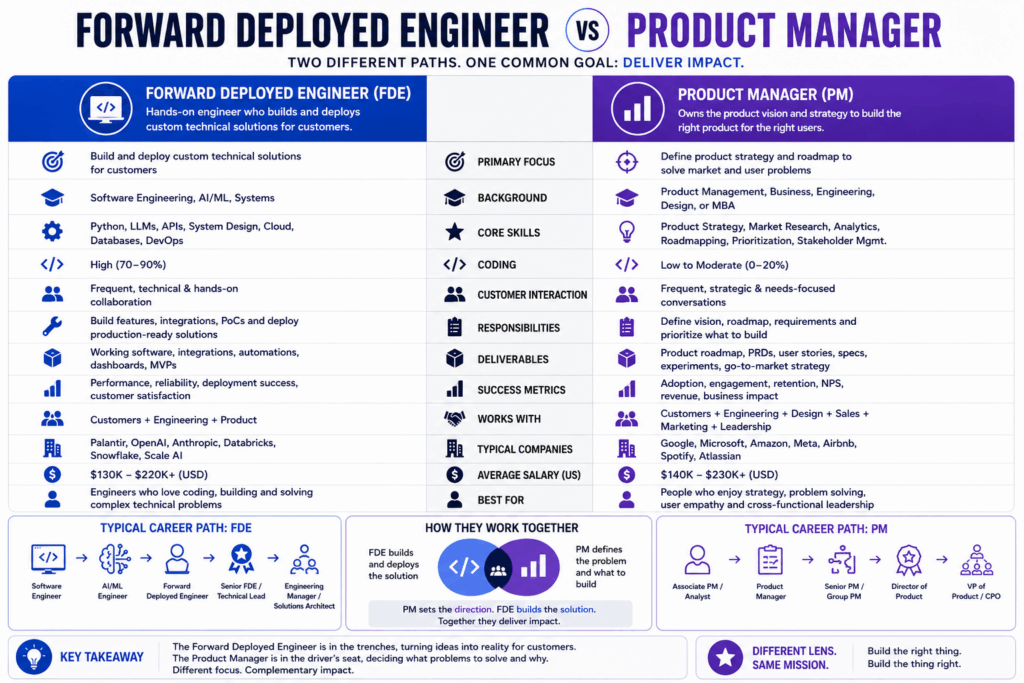
To understand the nuances of the Product Manager vs Forward Deployed Engineer dynamic, it helps to compare them across several key operational dimensions. While both aim to deliver value to the customer, their scope, timelines, and daily focus differ significantly.
| Dimension | Forward Deployed Engineer (FDE) | Product Manager (PM) |
|---|---|---|
| Primary Focus | Technical implementation, integration, and bespoke client solutions. | Product strategy, market fit, roadmap, and core feature definition. |
| Daily Tasks | Writing code, debugging integrations, system architecture, client technical consulting. | Writing PRDs, prioritizing backlogs, conducting user research, aligning stakeholders. |
| Coding Required? | Yes, highly technical. Expert coding skills are mandatory. | No, though technical literacy is highly beneficial. |
| Time Horizon | Short-to-medium term (getting the current client live and successful). | Medium-to-long term (shaping the product roadmap for the next 1-3 years). |
| Customer Interaction | Deep, technical interaction with a few specific enterprise clients. | Broad interaction with many users, market segments, and internal business stakeholders. |
1. Scope of Impact: Micro vs. Macro
An FDE’s impact is deep and immediate. They focus on making specific enterprise clients successful. If a major bank needs a custom machine learning pipeline integrated into their system, the FDE builds it. On the other hand, a PM’s impact is broad. They focus on building features that can scale to thousands or millions of users, ensuring the product remains generic enough to serve a massive market rather than just one client.
2. Technical Depth vs. Business Breadth
FDEs are, first and foremost, engineers. They must understand system architecture, APIs, and data infrastructure. For instance, in data-intensive platforms, an FDE might need to know how to optimize algorithms or utilize top data scientist skills to process massive datasets. PMs, conversely, need business breadth. They must understand unit economics, marketing, user psychology, and competitive landscapes.
Skills Required: FDE vs. Product Manager
The skill sets for these two roles reflect their differing areas of focus, though there is a shared requirement for excellent communication and problem-solving abilities.
Skills Needed for a Forward Deployed Engineer
- Software Engineering: Mastery of languages like Python, Java, or C++, along with system design principles. Knowing how to learn Python and apply it to real-world data pipelines is highly advantageous.
- Data Engineering & Integration: Proficiency in SQL, ETL processes, and cloud infrastructure (AWS, GCP, Azure).
- Consultative Communication: The ability to explain complex technical concepts to client-side stakeholders who may not be highly technical.
- Adaptability: Comfort with jumping into foreign codebases and legacy systems without extensive documentation.
Skills Needed for a Product Manager
- Product Sense & Empathy: The ability to understand user pain points and translate them into intuitive product features.
- Data Literacy: Analyzing metrics, running A/B tests, and making data-backed prioritization decisions.
- Strategic Prioritization: Frameworks like RICE (Reach, Impact, Confidence, Effort) to decide what gets built next.
- Influence Without Authority: Leading cross-functional engineering and design teams without being their direct manager.
Salary and Career Outlook
Both Forward Deployed Engineers and Product Managers are highly compensated, reflecting the high value they bring to tech organizations.
Forward Deployed Engineer Salary
FDE salaries are comparable to senior software engineering roles. Because they require a rare combination of deep technical expertise and client-facing soft skills, they command a premium. In the United States, the average salary for an FDE ranges from $130,000 to $190,000 per year, with total compensation (including equity and bonuses) often exceeding $250,000 at top-tier firms like Palantir or Snowflake.
Product Manager Salary
Product Manager salaries vary widely based on experience level (Associate PM to VP of Product). The average salary for a mid-level PM in the United States ranges from $110,000 to $160,000. Senior Product Managers and Directors easily earn upwards of $200,000 in base salary, with substantial stock grants in public tech companies.
How to Choose Between the Two Paths
If you are standing at a career crossroads, choosing between a Forward Deployed Engineer vs Product Manager role depends on what energizes you:
- Choose Forward Deployed Engineering if: You love writing code, solving complex technical integration puzzles, working directly with clients, and seeing the immediate, real-world impact of your code on a business.
- Choose Product Management if: You want to step away from daily coding, enjoy thinking about business strategy, like talking to diverse users, and want to own the long-term vision of what a product becomes.
How to Learn the Necessary Skills
If you are looking to transition into either of these high-growth roles, structured education is the fastest way to build a credible portfolio. For those aiming to master software engineering, system design, or data-driven product management, Scaler stands out as the premier accelerator program. Scaler offers a structured curriculum, hands-on industry projects, and invaluable 1:1 mentorship from top tech leaders to prepare you for elite engineering and product-adjacent roles.
Alternatively, you can explore self-paced learning platforms like Coursera, Udemy, or edX, which offer introductory courses in product management and basic software development, though they typically lack the personalized career support and mentorship found in dedicated programs like Scaler.
Frequently Asked Questions (FAQs)
1. Does a Forward Deployed Engineer write code every day?
Yes, FDEs are active software developers. While they spend a significant portion of their time in client meetings and gathering requirements, their core output is working code, integrations, and custom software solutions.
2. Can a Forward Deployed Engineer transition into a Product Manager role?
Absolutely. FDEs make exceptional Product Managers because they possess deep technical empathy and have spent years on the front lines understanding exactly how customers use products. This transition is quite common in enterprise SaaS companies.
3. Do Product Managers need to know how to code?
No, coding is not a strict requirement for most PM roles. However, having a technical background or understanding system architecture helps PMs communicate effectively with engineering teams and make realistic roadmap commitments.
4. Which role pays more: FDE or PM?
At the entry to mid-level, Forward Deployed Engineers often earn slightly more due to the specialized technical skills required. At senior and executive levels, the compensation is highly competitive for both, with Product Leaders (like VPs of Product) and Principal Engineers earning comparable top-tier compensation packages.
Conclusion
Both Forward Deployed Engineers and Product Managers play indispensable roles in the modern technology ecosystem. While the FDE ensures that the product successfully solves specific, complex client problems today, the Product Manager ensures that the product evolves to capture the broader market tomorrow.
If you are ready to take your technical or analytical skills to the next level, check out the comprehensive resources and industry-aligned masterclasses at the Applied AI Course to kickstart your journey in AI, data, and advanced software engineering.