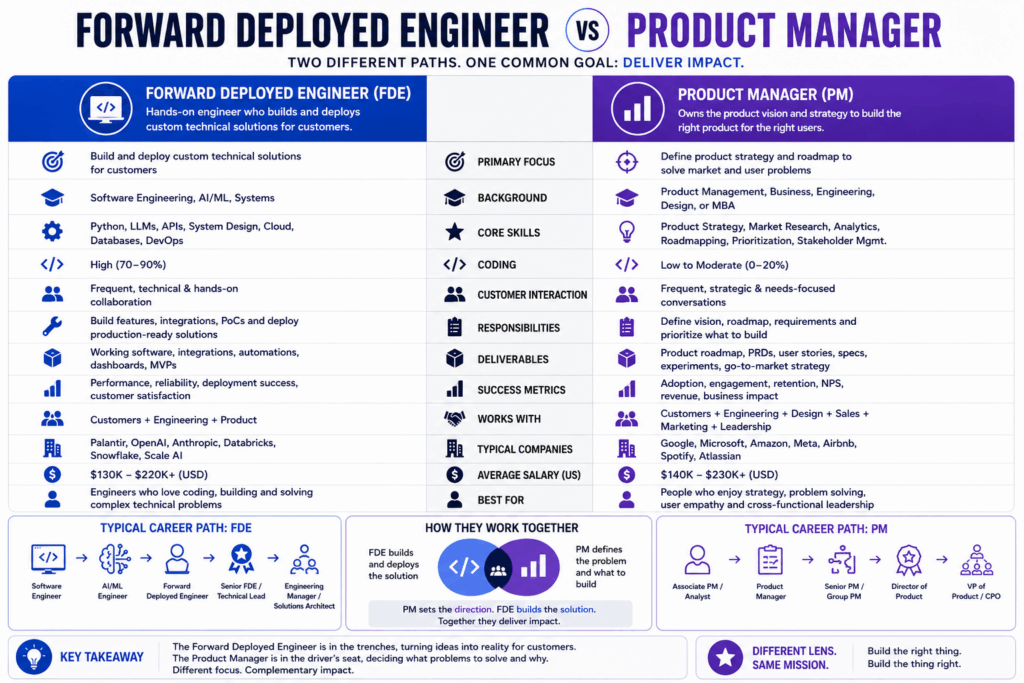
Introduction
The modern technology ecosystem is expanding rapidly, giving rise to specialized engineering roles designed to solve complex infrastructure and customer-facing problems. Two roles that often spark debate regarding their scope, responsibilities, and organizational value are the Forward Deployed Engineer (FDE) and the DevOps Engineer. When comparing the Forward Deployed Engineer vs DevOps Engineer, professionals often ask: Which role has more impact, and how do their daily contributions shape the success of an enterprise?
While both positions require deep technical expertise, they operate on opposite ends of the deployment spectrum. A DevOps Engineer focuses inward, building robust pipelines, maintaining cloud infrastructure, and ensuring operational reliability. On the other hand, a Forward Deployed Engineer works outward, collaborating directly with enterprise clients to integrate, customize, and scale complex software solutions on-site. Understanding the differences between a DevOps Engineer vs Forward Deployed Engineer is crucial if you are looking to pivot your career, hire the right talent, or optimize your engineering workflows.
What is a Forward Deployed Engineer?
A Forward Deployed Engineer (FDE) is a hybrid professional who combines the technical capabilities of a full-stack software engineer with the communication skills of a consultant. Popularized by enterprise software giants like Palantir, the FDE role exists to bridge the gap between a company’s core product and the unique, messy environments of its high-value clients.
FDEs spend their time embedded with the customer. They analyze client data systems, write custom integration code, and build bespoke solutions on top of the company’s core platform. Because enterprise clients often deal with massive, unorganized datasets, an FDE must have a strong grasp of data systems. They regularly leverage foundational skills like data processing and custom pipeline development to make sure the platform delivers immediate business value.
Key Responsibilities of an FDE
- Client Integration: Deploying complex software platforms within the client’s unique legacy infrastructure.
- Custom Feature Engineering: Writing custom APIs, wrappers, and data connectors tailored to client needs.
- Technical Consulting: Acting as the technical face of the company, translating client business requirements into concrete code.
- Feedback Loop Management: Relaying client pain points and feature requests back to the core product team to improve the main codebase.
What is a DevOps Engineer?
A DevOps (Development and Operations) Engineer is an infrastructure specialist focused on automating and optimizing the software delivery lifecycle. Rather than focusing on a single client, a DevOps Engineer builds the underlying systems that allow internal product developers to build, test, and release software rapidly and reliably.
DevOps Engineers are the architects of the modern cloud. They design Continuous Integration and Continuous Deployment (CI/CD) pipelines, manage cloud infrastructure via code (IaC), monitor system health, and ensure maximum uptime. Their work is highly scalable; a single DevOps engineer can build automation tools that support hundreds of internal software developers and millions of end-users.
Key Responsibilities of a DevOps Engineer
- CI/CD Automation: Designing and maintaining pipelines using tools like Jenkins, GitHub Actions, or GitLab CI.
- Infrastructure as Code (IaC): Managing cloud resources (AWS, GCP, Azure) using tools like Terraform or Ansible.
- Containerization & Orchestration: Packaging applications using Docker and managing them at scale with Kubernetes.
- Monitoring & Observability: Setting up logging, alerting, and monitoring systems using Prometheus, Grafana, or ELK stack to maintain system reliability.
Forward Deployed Engineer vs DevOps Engineer: Key Differences
To better understand how these two roles compare, let’s look at their core differences across several key dimensions.
1. Customer Interaction vs. Internal Systems
The most defining difference in the DevOps Engineer vs Forward Deployed Engineer comparison is where they spend their energy. FDEs are highly client-facing. They travel to client sites, sit in meetings with external stakeholders, and write code that directly addresses client business problems. DevOps Engineers, conversely, work almost entirely internally. Their “customers” are the internal software development teams who rely on the deployment pipeline and infrastructure to do their jobs.
2. Codebase Focus: Custom vs. Standardized
An FDE works with highly customized code. They must adapt their company’s core product to fit into a client’s messy, legacy ecosystem, which often requires writing unique integrations. This demands a strong analytical mindset to understand how data flows through disparate systems. In contrast, a DevOps Engineer strives for absolute standardization. Their goal is to eliminate custom, snowflake environments by using automated scripts to ensure every development, staging, and production environment is identical.
3. Skill Sets: Software & Communication vs. Systems & Automation
An FDE needs to be a strong software developer who can write clean code, but they also need exceptional soft skills to manage client relationships. They must understand the business logic of the industries they serve. For example, if they are deploying a machine learning platform, they must understand how to handle data preprocessing in data science to ensure the customer’s data is ready for modeling.
A DevOps Engineer, on the other hand, focuses deeply on systems engineering, networking, security, and automation scripting. While they need to write code (often in Python, Go, or Bash), their focus is on system configuration, infrastructure orchestration, and cloud architecture rather than building application features.
Comparison Table: FDE vs DevOps
| Feature | Forward Deployed Engineer (FDE) | DevOps Engineer |
|---|---|---|
| Primary Focus | Client-side integration and custom software delivery | Internal system automation, infrastructure, and CI/CD |
| Work Environment | Client-facing, highly collaborative, often on-site | Internal-facing, collaborative with product/dev teams |
| Key Technologies | Full-stack languages (Python, Java, Go), SQL, APIs | Docker, Kubernetes, Terraform, AWS/GCP, Jenkins |
| Core Skill Set | Software development, system integration, consulting | Cloud infrastructure, automation, system networking |
| Customization Level | High (tailored to specific customer environments) | Low (focuses on standardized, reproducible setups) |
| Impact Metric | Client success, retention, and rapid deployment of solutions | System uptime, deployment frequency, infrastructure cost |
Which Role Has More Impact?
Determining which role has “more” impact depends entirely on how an organization measures value. Both roles are highly impactful, but their contributions are realized in very different ways.
The Impact of a Forward Deployed Engineer
The impact of an FDE is immediate, visible, and directly tied to revenue. When an enterprise software company signs a multi-million-dollar contract, it is often the FDE who ensures that the customer actually derives value from the product. By building custom integrations and solving complex data bottlenecks on-site, FDEs prevent churn, secure contract renewals, and unlock new business opportunities. For organizations dealing with massive data pipelines, an FDE’s ability to streamline the ingestion process is invaluable to the business bottom line.
The Impact of a DevOps Engineer
The impact of a DevOps Engineer is foundational, highly scalable, and long-term. While they may not directly close a sales deal, they build the infrastructure that allows the entire company to scale. Without a solid DevOps foundation, developers cannot release features quickly, systems experience downtime, and security vulnerabilities go unchecked. A DevOps Engineer’s impact is measured in efficiency: saving engineering hours, reducing cloud infrastructure costs, and ensuring that the platform can support millions of concurrent users without breaking.
Which Career Path Should You Choose?
If you are deciding between pursuing a career as a Forward Deployed Engineer vs DevOps Engineer, consider your personal strengths and career goals:
- Choose Forward Deployed Engineering if: You love solving real-world business problems, enjoy working directly with people, want to travel, and prefer writing application-level code to solve domain-specific challenges. It is an excellent path for engineers who eventually want to transition into Product Management, Technical Sales, or Entrepreneurship.
- Choose DevOps Engineering if: You are passionate about automation, cloud architecture, system security, and scalability. If you prefer working behind the scenes to build highly reliable, automated systems and enjoy the challenge of managing complex infrastructure, DevOps is a highly lucrative and stable career choice.
Conclusion
In the debate of DevOps Engineer vs Forward Deployed Engineer, there is no single winner. The Forward Deployed Engineer drives outward impact by ensuring enterprise clients successfully adopt complex platforms, while the DevOps Engineer drives inward impact by building the scalable, automated foundation that keeps the entire product ecosystem running smoothly.
As industries increasingly rely on data-driven technologies, both roles require a solid foundation in engineering principles. If you are ready to elevate your technical skills, master modern software paradigms, or dive deep into data technologies, check out the comprehensive programs at Applied AI Course to jumpstart your career journey today.
Frequently Asked Questions (FAQs)
1. Does a Forward Deployed Engineer write code daily?
Yes, Forward Deployed Engineers write a significant amount of code. However, unlike traditional software engineers who write core product features, FDEs focus on writing custom integration pipelines, APIs, and data connectors to adapt the core product to the client’s infrastructure.
2. Is DevOps a software development role?
DevOps is a hybrid of software development and systems operations. While DevOps Engineers do write code (primarily for automation, scripting, and infrastructure configuration), their primary focus is on managing the system and deployment pipelines rather than building user-facing application features.
3. Do Forward Deployed Engineers travel a lot?
Typically, yes. Because FDEs work closely with enterprise clients, they often spend a significant amount of time traveling to and working directly from client offices, especially during the initial integration and deployment phases of a contract.
4. Which role pays more: FDE or DevOps?
Both roles are highly compensated. FDE salaries can sometimes skewed higher at top-tier companies (like Palantir) due to the hybrid requirement of strong engineering skills combined with client-facing consulting capabilities. However, senior DevOps and Site Reliability Engineers (SREs) also command exceptionally high market salaries due to the critical nature of cloud infrastructure management.